Greater London · England
Asbestos Removal for Marylebone
Buildings in Marylebone built or refurbished before 2000 can contain asbestos. Our asbestos removal service covers removal of asbestos cement, coatings, tiles, flues and tanks.
- Floor tiles before a new floor
- Debris left from a previous job
- Asbestos garages
Get a quote for Marylebone
Questions from Marylebone
Is asbestos common in Marylebone homes?
Older homes can, if they date from before 2000. The only way to know is to test suspect materials. Garage roofs, Artex, floor tiles, soffits and flues are typical examples.
Can you work in Marylebone with London’s parking rules?
We do. Let us know the parking situation and we’ll plan around it.
Can you help a business or landlord?
We do. Landlords, agents, businesses and builders all use our services.
Where does the asbestos go?
It’s double-bagged or wrapped, labelled and taken to a permitted site by a registered waste carrier, and you get the consignment note.
Can asbestos be left in place?
It doesn’t always have to come out: material in good condition that will not be disturbed can often be left and managed. Keep a record and check it from time to time.
Can I remove asbestos myself?
HSE’s advice is not to do it yourself, and higher-risk materials are strictly for licensed contractors.
How do I get a quote?
Start with the postcode and a description of the material. To do that, call 07833 053 749 or use our quote form.
Can you advise before I buy a property?
Yes. A pre-purchase survey tells you what’s there before you exchange, with the seller’s permission.
About our asbestos removal in Marylebone
Higher-risk materials such as pipe lagging, sprayed coatings and most insulating board are licensed work, and has to be done by an HSE-licensed contractor. We’ll tell you if your job in Marylebone falls into that category. Typical materials include gutters and downpipes, flue pipes and cement soffits, and people generally contact us about cement flues and gutters and old sheds and coal bunkers.
In London neighbourhoods like Marylebone, garages and outbuildings are often reached through the house or a rear lane, which affects how the waste is carried out. Every quote is in writing and spells out what’s covered, so there are no surprises.
- Location
- Marylebone (W1U, W1T, W1K)
- County
- Greater London
- Service
- Removal and disposal of asbestos materials
- Afterwards
- Waste paperwork
- Price
- Quoted individually, in writing
- Call
- 07833 053 749
- Updated
- 26 October 2026
What it costs
We base our quote on:
- The quantity or area
- Waste quantity and disposal
- Parking and access charges
- The category of work
Access makes a big difference to cost, so tell us about access.
Sending photos
The most useful photos are:
- A close-up from a safe distance
- Any labels or markings, if you can see them safely
- A photo of the whole area
- The route in: gates, steps, stairs or the loft hatch
Every job is quoted in writing. Use our quote form or call 07833 053 749 with the details, including any survey or test you already have.
Which option is right?
Should it come out? Sound material that will not be disturbed can often stay; if it’s damaged or in the way of work, removal is typically right. We do not publish a price list, because jobs vary so much. Our guides list published price ranges from other companies, with sources.
Why choose us
- Clear advice on your options
- Quotes that spell out the scope
- Work done to the regulations
- No removal until we know what it is
See how we price jobs and published price ranges.
A closer look at the materials
Asbestos cement
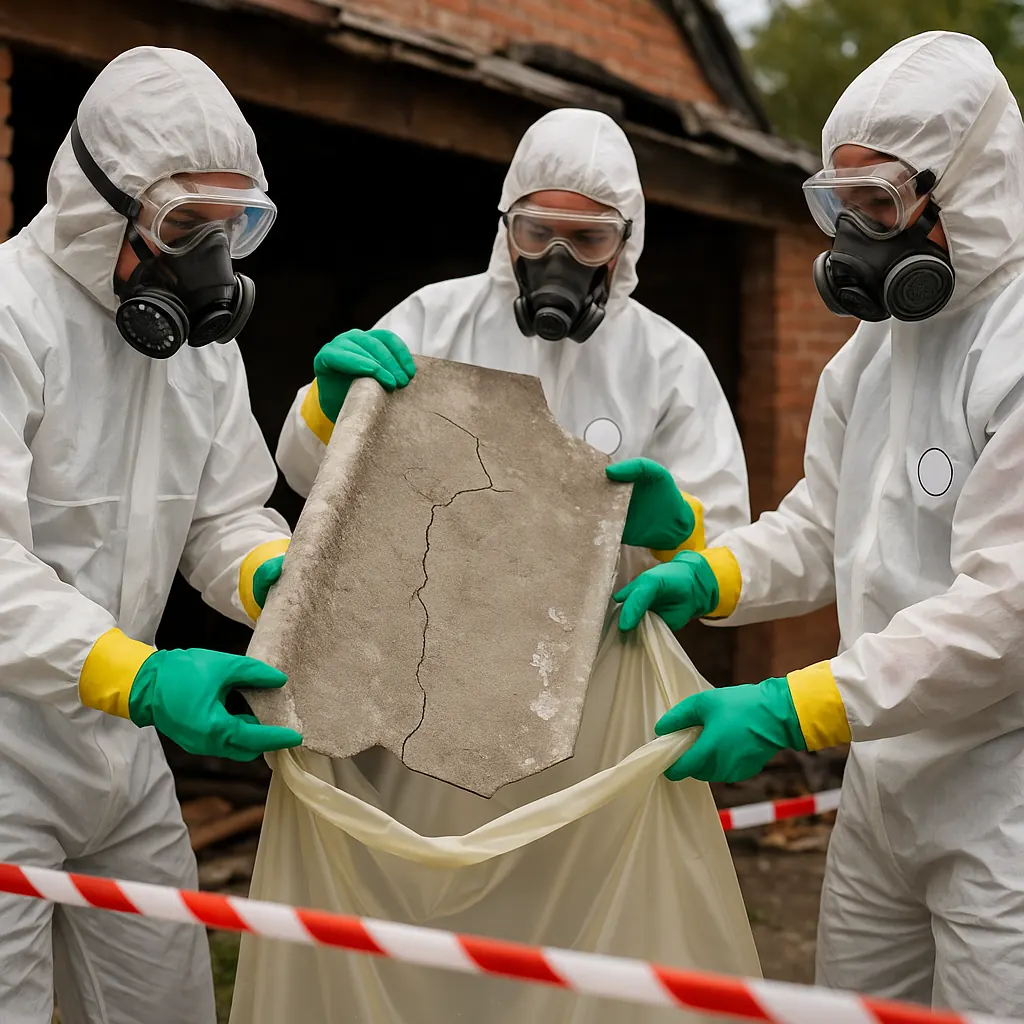
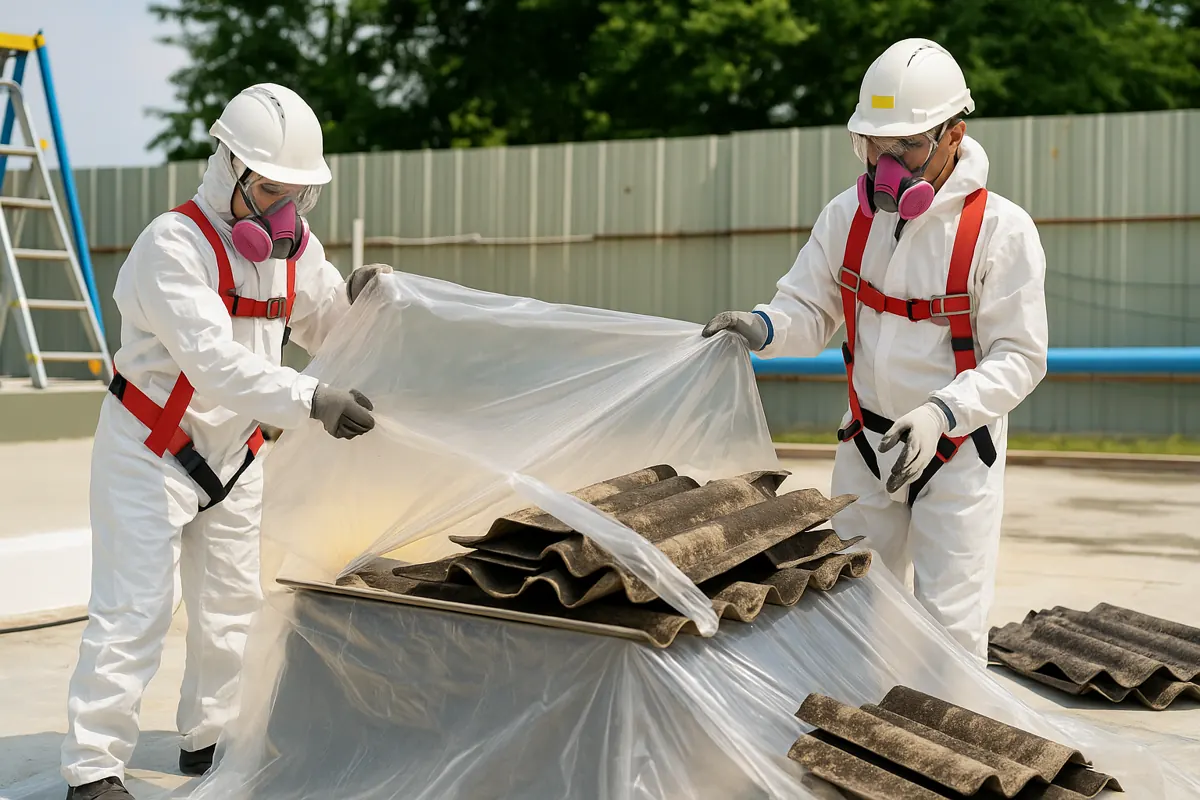
Asbestos cement is the most common material we remove: roof sheets, gutters, downpipes, flues, soffits and water tanks. We wet it and take it down in whole pieces where we can.
Floor tiles
The adhesive underneath sometimes needs its own approach.
What happens next
Any asbestos left elsewhere should stay on record, for anyone working there later.
Keeping things safe:
- Let us know where we can park
- Tell neighbours if the work is close to their property
- Book the replacement before removal
- Photos of the material and the route in help
Things not to do
Do not sweep, vacuum or brush up broken asbestos debris.
Do not let anyone remove asbestos without asking how the waste will be disposed of, and ask for the consignment note.
Good to know
Some limits to bear in mind:
- Unidentified materials are tested before removal is planned
- Some jobs must be notified first, so the timing needs planning
- Replacing what’s removed, such as a roof or ceiling, is typically separate
If you are unsure, describe the job and send photos, and we will advise.
Common materials
- Flue pipes
- Panels and boards
- Artex and textured coatings
- Garage and shed roofs
- Floor tiles and adhesive
- Gutters and downpipes
- Water tanks
- Asbestos cement sheets
- Soffits (cement)
- Bitumen roof felt
Step by step
We wear disposable coveralls and suitable respirators, and nobody else enters the work area. If anything unexpected turns up, we stop and talk to you before carrying on. We plan outdoor jobs in Marylebone to finish before dark: that means by about 3:55pm in December, or about 9:20pm in June.
- Describe the material and send pictures
- We identify it if needed and plan the method
- We send a quote covering the work and the waste
- We remove it with controls to keep fibres down
- We clean up and send you the waste paperwork
How to prepare
- Warn neighbours if needed
- Keep children and pets away on the day
- Do not disturb the material before we get there
Ask for a quote
To get a quote, send photos through our quote form, or phone 07833 053 749. Tell us the postcode, what the material is and where, and send photos if you can.
Related guides
Removal jobs in Marylebone
Marylebone is about 3 miles north-west of London, in Greater London. We cover Marylebone as part of Greater London, for removal jobs of every size. We cover 764 places in Greater London, from the larger towns to small villages.
At a school such as St Vincent's Catholic Primary School, removal would be arranged with the duty holder, with the area empty. If you’re on or near the A400 and A401, tell us about parking and loading.
We cover removal jobs across the W1U, W1T and W1K postcode area. Streets in the area include Park Lane, Duck Lane and Bruton Lane, and asbestos removal is available on all of them. Marylebone sits on or near the A400 and A401; tell us about parking if you’re on a main road. If your property is just outside Marylebone, we also cover City of Westminster (1 mile south-west), Mayfair (1 mile south), Fitzrovia (1 mile north-east), Burlington Estate (1 mile south-east) and Soho (1 mile south-east). Within a short drive, we also work in London (3 miles south-east), Kensington (3 miles south-west), Shoreditch (3 miles east), Walthamstow (7 miles north-east), Hoxton (3 miles north-east) and Whitechapel (3 miles east). Marylebone is among the bigger towns we cover in Greater London, with homes, rented property and workplaces of every age.
Marylebone is in London, inside the Ultra Low Emission Zone, where parking and loading can be restricted: let us know about parking and access when you get in touch.
Nearby you will also find Twist Museum (less than half a mile south-east) and Montfichet's Tower (2 miles east). The countryside around Marylebone includes Adelaide Nature Reserve and St. James's Park Lake.
- Local schools include The St Marylebone CofE School (less than half a mile north-west) and The St Marylebone CofE School (less than half a mile north-west)
- Local pubs include The Phoenix pub (less than half a mile south-east)
- Other local spots include Royal Society of Medicine Library (less than half a mile south) and Westminster St James (0.8 miles south-east)
Doing it yourself?
Working on a fragile asbestos cement roof is dangerous in itself, as well as an asbestos risk, so stay off it.
HSE advises the public not to repair or remove asbestos themselves. Higher-risk materials such as lagging, sprayed coatings and most insulating board must only be dealt with by an HSE-licensed contractor.
Places near Marylebone
More for properties in Marylebone
Duty holders and landlords in Marylebone
Duty holders for workplaces and the shared parts of flats in Marylebone must manage asbestos under the Control of Asbestos Regulations 2012. In practice: find it, assess it, record it and manage it.
Contractors working for you need asbestos information before they start. HSE’s campaigns stress this point to building owners and trades alike.
- Survey or test first when it isn’t clear what a material is
- Work planned to the Control of Asbestos Regulations 2012 and HSE guidance
- Written paperwork: reports, results and waste consignment notes
- Legal disposal at a permitted site, with a consignment note