Kent · England
Asbestos Survey in Little Chart
Found something that might be asbestos in Little Chart? Our service covers asbestos surveys for homes, landlords and businesses, with clear advice at each step.
- Shared halls, stairs and plant rooms
- Pre-purchase checks on older properties
- Schools, halls and community buildings
Asbestos help in Little Chart
Asbestos survey for Little Chart properties
HSE’s guidance describes two main survey types. A management survey covers a building in everyday use, while a refurbishment and demolition survey is needed before work starts. We will tell you which suits your plans in Little Chart. We often deal with textured ceilings, soffits and pipe lagging, and typical jobs are public and community buildings and demolition of garages, extensions and buildings.
Village houses like those in Little Chart have often been extended and altered over time, so we survey each part the work will disturb. We work to HSE guidance on every job, large or small.
- Location
- Little Chart (TN27)
- Area hub
- Kent
- What we do
- Asbestos surveys with lab-analysed samples
- You receive
- Written survey report
- Quotes
- Written quote for your job
- Telephone
- 07833 053 749
- Page updated
- 26 October 2026
FAQs for Little Chart
Do you work on properties in the Kent Downs National Landscape?
Yes, the same rules apply there, though access to rural buildings may need planning.
Do you cover small places like Little Chart?
Yes. We cover villages and hamlets as well as towns. Just tell us how to reach the property.
How do I know if my property contains asbestos?
You can’t tell by eye. A sample analysed in a laboratory is the reliable way to find out, especially in buildings from before 2000.
Should all asbestos be removed?
Not always: sound material that won’t be disturbed can often stay. Keep a record and check its condition.
When can you start?
We agree a date when you accept the quote. Notifiable jobs can’t start until they’ve been notified.
Can you survey offices and warehouses?
We do: shops, offices, warehouses, industrial units, schools and halls. Tell us about the building and what you need.
Do I need an asbestos survey before renovating?
Yes, for the areas affected: HSG264 says refurbishment and demolition work should be preceded by a refurbishment and demolition survey.
What does the survey report include?
Locations, results, condition, photos and what we recommend for each material. Areas not accessed are listed too.
Weighing up your options
A building survey for a purchase is not the same as an asbestos survey. It may flag possible asbestos, but it does not normally take samples, which is where a pre-purchase asbestos survey comes in. How easy the material is to reach affects the price, so photos of the area and the way in help us quote accurately.
Why people choose us
- Written quotes that say what’s included
- Every main survey type
- Across London and the South East
- Inaccessible areas listed clearly
Take a look at our prices page and our cost guide.
What we do and do not cover
Every job has limits; these are the usual ones:
- The report describes the building when surveyed; materials can deteriorate, so condition should be checked again over time
- A management survey does not open up walls, floors or ceilings, so it is not enough before refurbishment
- A refurbishment and demolition survey needs the areas to be empty, so timing needs planning
Not sure what you need? Send us photos and we will tell you honestly before booking.
What we deal with
- Garage and shed roofs
- Ceiling tiles
- Roofing felt and bitumen
- Pipe lagging
- Artex and textured coatings
- Boiler cupboards and panels
- Cement sheets and cladding
- Soffits and porch canopies
- Water tanks and flues
- Floor tiles and adhesive
Materials, one by one
Textured coatings
Textured coatings such as Artex were used on ceilings and walls, and older ones can contain a small amount of asbestos. Left alone they’re low risk; sanding or dry scraping is the problem.
Roofing felt and bitumen
Felt on flat roofs and outbuildings is sampled where it’s in scope.
Surveys around Little Chart
Little Chart is about 5 miles north-west of Ashford, in Kent. Little Chart is within our Kent area, for surveys of every size. We cover 922 places in Kent. You can also see our page for Canterbury, about 15 miles away.
If you manage lettings around Charing station, a survey gives contractors the information they need. Little Chart is within about 7 miles of the Kent Downs National Landscape, where farm buildings, barns and stables with cement roofs are common.
Surveys anywhere in TN27 start with the postcode and some photos. We also carry out surveys in Little Chart Forstal (1 mile east), Pluckley (1 mile west), Fir Toll (2 miles south-west), Pluckley Thorne (2 miles west) and Chambers' Green (2 miles south-west). Further out, we also cover Maidstone (13 miles north-west), Ashford (5 miles south-east), Canterbury (15 miles north-east), Sittingbourne (12 miles north), Faversham (10 miles north-east) and Hythe (15 miles south-east).
Other landmarks nearby include Romden Castle (3.8 miles south-west).
- Local pubs include The Swan Inn And Former Stables (under half a mile north-west)
Afterwards
After the survey you get a written report: locations, results, condition and recommendations for every material in scope.
To avoid problems in future:
- Keep children and pets away from the areas being surveyed
- Clear access to lofts, garages, cupboards and outbuildings
- Book the survey before booking builders
- Describe the work you’re planning, so the scope matches
Don’ts
Plan the survey early, before booking builders, so there is time to deal with anything it finds.
If something has been damaged already, close the area off and let us know.
Should you do it yourself?
Power tools, sanding and jet-washing release the most fibres.
Never put asbestos in a bin or skip. It must go to a permitted site; check with your council about small amounts.
What it costs
Every quote reflects:
- Parking and access charges
- The size and age of the building
- Roof spaces and outbuildings in scope
- The type of survey you need
Identifying asbestos early is cheaper than stopping work later, when the whole project can be held up.
What to photograph
A few photos can save a site visit:
- Damaged areas
- How we’d reach it
- A rough size or measurement
- Any labels or markings, if you can see them safely
You will get a written quote. Just fill in the enquiry form or give us a call on 07833 053 749 with the details.
Places near Little Chart
What else we do in Little Chart
What happens
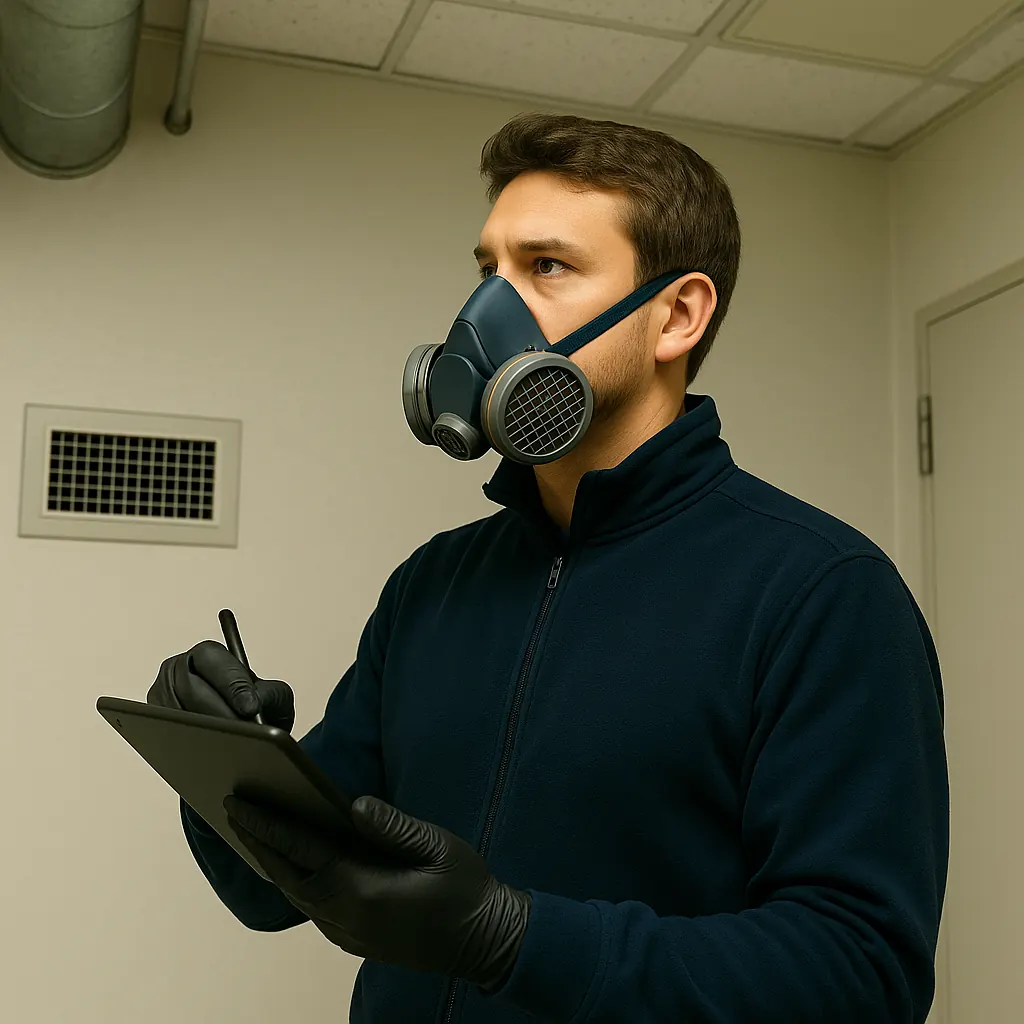
A management survey involves minor intrusion: lifting ceiling tiles, opening service cupboards and taking small samples. Sample points are sealed afterwards. Our team uses the right protective equipment, and use controls to keep dust down.
- Tell us about the building, its age and why you need a survey
- We agree the type of survey and the areas it covers, and send a quote
- On the agreed day, the surveyor inspects, photographs and samples
- An accredited laboratory analyses the samples
- The report comes to you, and we explain anything that isn’t clear
Before we arrive
- Clear the way to the work area
- Move belongings away from the area, without touching the material
- Have any previous surveys or test results ready
Ask for a quote
Photos taken from a safe distance are fine: send them through our contact page.
Related guides
For landlords, agents and businesses
If you are responsible for a non-domestic building or the common parts of flats in Little Chart, you have a duty to manage asbestos under regulation 4 of the Control of Asbestos Regulations 2012. That means finding it, assessing it, recording it and planning how to manage it.
Contractors working for you need asbestos information before they start. HSE’s campaigns stress this point to building owners and trades alike.
- Nothing removed blind: unknown materials are tested first
- Work planned to the Control of Asbestos Regulations 2012 and HSE guidance
- Paperwork for your records: reports, lab results and consignment notes
- Asbestos waste double-bagged or wrapped and taken to a permitted site