Isle of Wight · England
Asbestos Surveys in St Lawrence, Isle of Wight
Asbestos survey across St Lawrence and nearby. Done to HSE guidance, with paperwork for your records.
- Pre-work surveys for trades
- Demolition projects
- Pre-purchase checks on older properties
Need an asbestos survey in St Lawrence?
Materials we deal with
Asbestos cement
Asbestos cement was used for garage and shed roofs, gutters, downpipes, flues, soffits and water tanks. The fibres are bound in cement, and breaking or cutting it releases them.
Insulating board
Asbestos insulating board was used for panels, partitions, soffits, ceiling tiles and around heaters. Most work on it is licensed, so identifying it matters.
About our asbestos survey in St Lawrence
Buying an older property in St Lawrence? A pre-purchase survey tells you what’s there before you exchange, so you can plan renovations with your eyes open. We often deal with soffits, boiler cupboard panels and flues, and people normally contact us about common parts of flats and HMOs and schools, halls and community buildings.
Rural homes near St Lawrence have often been extended over generations, so we survey each part the work will disturb. We explain what we find in plain English, including when leaving a material alone is the sensible choice.
- Where
- St Lawrence (PO38)
- County
- Isle of Wight
- Service
- Asbestos surveys with lab-analysed samples
- Paperwork
- Written survey report
- Quotes
- Quoted individually, in writing
- Phone
- 07833 053 749
- Page updated
- 26 October 2026
Also in St Lawrence
Common reasons for surveys in St Lawrence
Materials age: a board or coating that was sound years ago may now be cracked or crumbling, which a survey records.
These come up again and again:
- Contractors’ requests for an asbestos report
- Community buildings and halls
- Pre-purchase checks on older properties
- Kitchen, bathroom and rewiring projects
Public buildings around St Lawrence, such as leisure centres and halls, are non-domestic premises, so their owners must manage any asbestos.
Before booking anyone
- What the report or result will contain
- The number of samples
- Which areas and materials are covered
- Survey methods in line with HSG264
Can I do it myself?
With a professional job, you get a record: a record that buyers, insurers and builders may want to see.
Found something mid-DIY? Stop: keep people away, do not sweep or vacuum it up, and get advice.
Questions from St Lawrence
Do you cover small places like St Lawrence?
We do: small villages are covered too. Just tell us how to reach the property.
Do you work near Shanklin station?
Yes, we cover St Lawrence and the area towards Shanklin station, about 4.1 miles north-east.
Do I get anything in writing afterwards?
It depends on what we do: a survey report, a laboratory result, or a consignment note for removed waste.
Will I get the price in writing?
Yes, every quote is in writing and says what’s included.
How do I know if my property contains asbestos?
If it was built or refurbished before 2000, it may. Only laboratory analysis of a sample can confirm it.
What’s the difference between a test and a survey?
Testing covers particular materials, while a survey covers everything in scope. Before building work, you normally need a survey.
Do you survey commercial buildings in St Lawrence?
We do: commercial, industrial and community buildings. Send us the size, use and age of the building.
Should I check for asbestos before buying?
Yes. A pre-purchase survey tells you what’s there before you exchange, as long as the seller agrees.
Afterwards
Share the report with builders and trades before they start, so nobody disturbs asbestos by accident.
Staying safe afterwards:
- Describe the work you are planning, so the scope matches
- Let us know about locked rooms or unsafe areas
- Keep children and pets away from the areas being surveyed
- In a block of flats, ask for the register of the shared areas
What to avoid
Plan the survey early, before you book builders, so there’s time to deal with anything it finds.
If something has been damaged already, close the area off and let us know, rather than cleaning it up.
Step by step
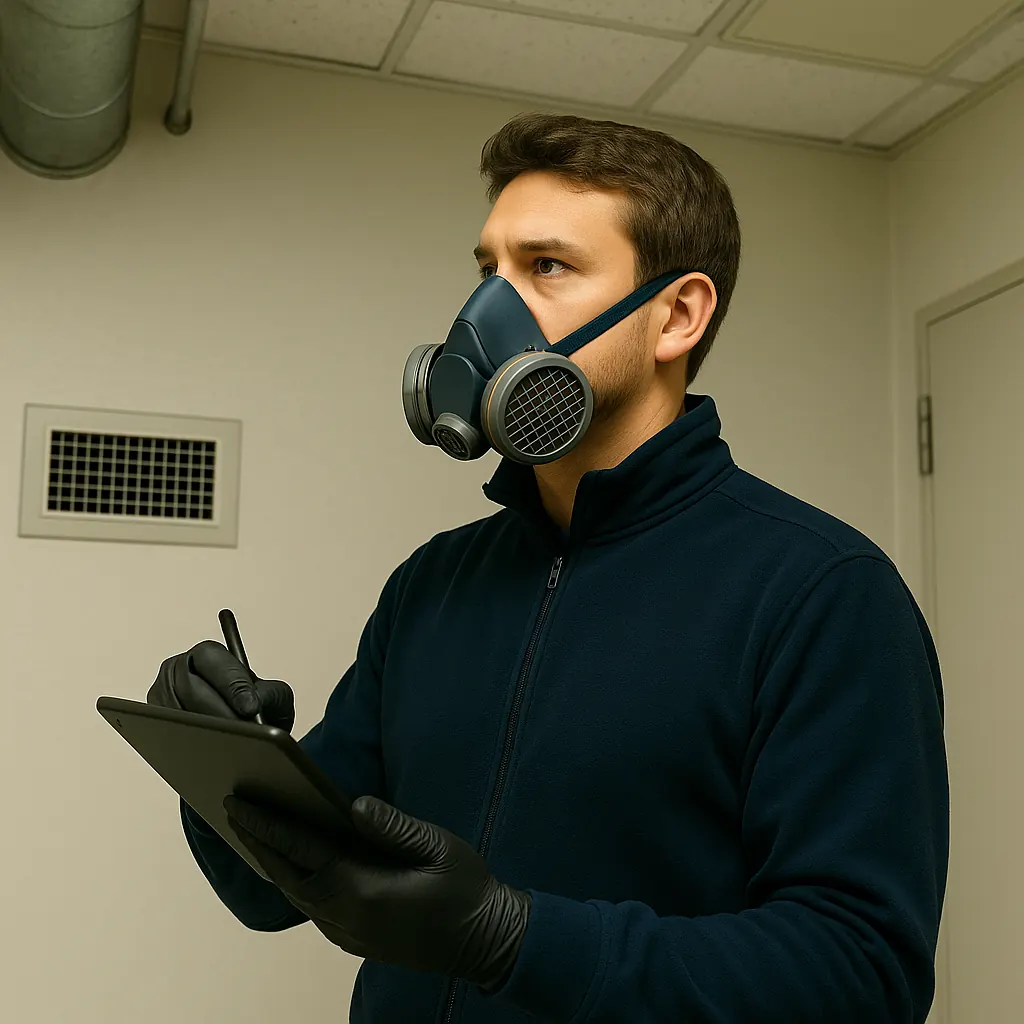
On the day, the surveyor walks through the areas in scope, checks every suspect material and takes small samples, with each sample point damped and sealed afterwards. We go over the plan with you first, so you know what’s happening.
- Tell us about the building, its age and what you are planning
- We set out the survey type, the areas covered and the price in writing
- The surveyor inspects and takes samples
- Each sample is analysed by an accredited laboratory
- We send the report and explain the findings
Before we arrive
- Move things out of the way carefully
- Let us know if something’s broken
- Keep away from the material in the meantime
Getting a price
Tell us about the material, its location and your plans. Then call 07833 053 749 or use our quote form.
Helpful guides
Prices and what affects them
We base our quote on:
- The survey type
- What the material is and its state
- The number of materials to sample
- Parking and access charges
How easy the material is to reach affects the price, so tell us about access.
What to photograph
Photos help us understand the job before we visit. Take them from a safe distance without touching the material:
- A wide shot showing where the material is
- How we’d reach it
- Damaged areas
- A rough size or measurement
We quote each job individually, because no two are the same. To start, call 07833 053 749 or use our quote form.
What’s included, and what is not
The usual limits are:
- Inaccessible areas are recorded, and must be treated as containing asbestos until checked
- The survey tells you what’s there; removal is a separate job, though we can quote for that too
- A management survey doesn’t open up walls, floors or ceilings, so it will not do before building work
If you’re unsure, describe the job and send photos, and we will advise.
What we deal with
- Cement sheets and cladding
- Water tanks and flues
- Pipe lagging
- Artex and textured coatings
- Garage and shed roofs
- Ceiling tiles
- Soffits and porch canopies
- Roofing felt and bitumen
- Boiler cupboards and panels
- Floor tiles and adhesive
Surveys around St Lawrence
St Lawrence is about 4 miles south-west of Shanklin, in the Isle of Wight. Wherever your property is in St Lawrence, tell us the postcode and what you need. We cover 125 places across the Isle of Wight, from the larger towns to small villages. Our nearest city page is Southampton, about 24 miles away.
If you manage lettings around Shanklin station, share asbestos information with trades before work. Altering an older house in St Lawrence, wherever it is? Get the work areas surveyed before anything is opened up. St Lawrence is within about 2 miles of the coast, and coastal properties often have porches, canopies and outbuildings that a survey can include.
We carry out surveys all over the PO38 postcode area and the streets around it. Whether your property is on Twining Road, Whitwell Road and Woolverton Road or a nearby road, we can help. We also carry out surveys in Steephill (1 mile east), Nettlecombe (1 mile north-west), Whitwell (1 mile north-west), Ventnor (1 mile east) and Bierley (2 miles north-west). We also cover nearby towns such as Newport (8 miles north), Ryde (10 miles north), Cowes (12 miles north), Sandown (6 miles north-east), Shanklin (4 miles north-east) and East Cowes (12 miles north). If the property is somewhere remote, let us know early and we’ll plan the trip.
St Lawrence is a more remote spot, so tell us early and we’ll plan the journey.
A little further out are South Wight (1.9 miles north-east) and Longshoremans Museum (1.3 miles east). The countryside around St Lawrence includes Stenbury Down.
- Local schools include The Island Free School (1.2 miles north-east) and St Catherine's School (1.5 miles east)
For landlords, agents and businesses
If you own a block of garages or outbuildings that you let should know what the roofs are made of, before repairs are arranged.
Between tenancies is a good time to deal with asbestos, while the property is empty.
- Identify it first: we test or survey before planning removal
- Done to the regulations: HSE guidance and CAR 2012
- Paperwork for your records: reports, lab results and consignment notes
- Waste sealed and labelled, then taken to a permitted site