Slough · England
Asbestos Survey for Wexham Street
Found something that might be asbestos in Wexham Street? We provide management, refurbishment and demolition, and pre-purchase asbestos surveys, explained in plain English.
- Shared halls, stairs and plant rooms
- Surveys requested by builders before work
- Shops, offices and industrial units
Asbestos survey near Wexham Street
FAQs for Wexham Street
Is asbestos common in Wexham Street homes?
If your home in Wexham Street was built or refurbished before 2000, it may, but you can’t tell by looking. Garage roofs, Artex, floor tiles, soffits and flues are typical examples.
How far is Wexham Street from London?
Wexham Street is about 21 miles from central London, well within our area.
How do I know if my property contains asbestos?
Any building built or refurbished before 2000 can contain asbestos. Testing a sample is the only way to know.
How can I get a price?
Start with the postcode and a description of the material. Then call 07833 053 749 or use our quote form.
What should I do if I’ve disturbed asbestos?
Get everyone out of the area and keep it closed. Don’t try to clean up the debris yourself, then contact a professional.
My builder has found asbestos. What now?
Work in that area should stop, and the material needs identifying before work resumes.
Is a home built after 2000 likely to contain asbestos?
Homes built after 2000 shouldn’t contain asbestos, as it was banned in 1999, though older parts, reused materials or earlier outbuildings can.
Does a survey leave holes?
Only minimally for a management survey: small samples are taken and the points sealed. A refurbishment and demolition survey opens up the areas being worked on, by design.
How asbestos survey works in Wexham Street
About to refurbish in Wexham Street? HSE’s guidance calls for a refurbishment and demolition survey of the areas being worked on before the work starts, so nothing hidden is disturbed once work begins. People often contact us about shared halls, stairs and plant rooms and pre-purchase checks on older properties, involving soffits, water tanks and textured ceilings.
Around a village like Wexham Street, a survey may need to cover a farmhouse, its extensions and several outbuildings. We explain what we find in plain English, including when leaving a material alone is the sensible choice.
- Where
- Wexham Street (SL2, SL3)
- County
- Slough
- Covers
- Management, refurbishment and demolition, and pre-purchase surveys
- You receive
- Survey report and lab results
- Price
- Written quote for your job
- Telephone
- 07833 053 749
- Updated
- 26 October 2026
How it works
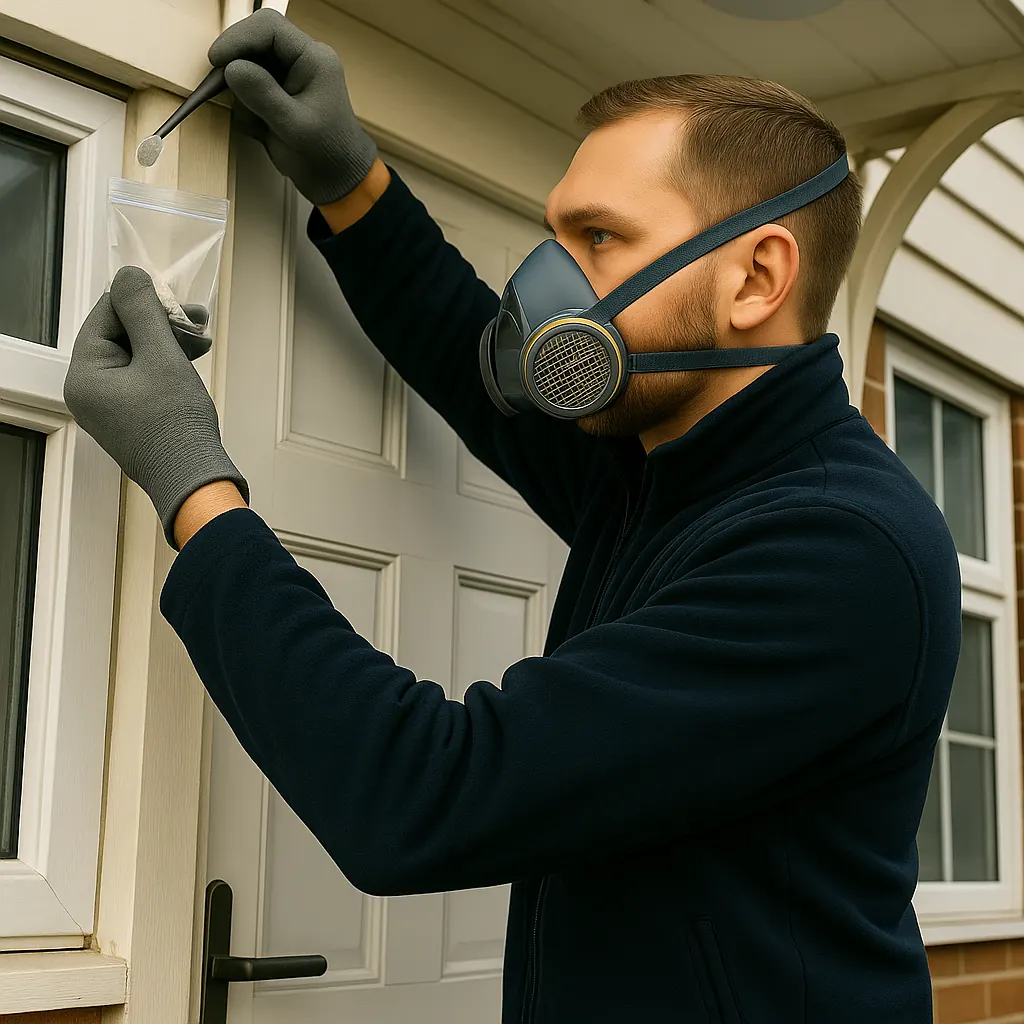
Our surveyor inspects each area in scope and samples suspect materials, wetting and sealing each sample point to keep dust down. We go over the plan with you first, so you know what’s happening.
- Describe the property and the reason for the survey
- We set out the survey type, the areas covered and the price in writing
- The surveyor inspects and takes samples
- Each sample is analysed by an accredited laboratory
- We send the report and explain the findings
Before we arrive
- Move belongings away from the area, without touching the material
- Keep the area clear of children and pets
- Mention any damage before we arrive
Ask for a quote
Photos taken from a safe distance are fine: send them through our contact page.
Helpful guides
Materials, one by one
Floor tiles and adhesive
Older floor tiles and the black glue under them may contain asbestos. They’re often hidden under newer flooring.
Pipe lagging
Lagging found in a survey is flagged clearly, and must be left alone in the meantime.
Places near Wexham Street
What else we do in Wexham Street
After the job
Keep the report somewhere safe and share it with anyone working on the building, so they know what to avoid or plan around.
After we’ve finished:
- Tell us exactly what work you’re planning, so the survey covers the right areas
- Survey first, then book the trades
- Let us know about locked rooms or unsafe areas
- In a block of flats, ask for the register of the shared areas
What to avoid
Please do not break off pieces for us to look at: sampling is part of the survey, done with controls to keep dust down.
Plan the survey early, before booking builders, so the results can shape your plans and your budget.
Asbestos surveys in Wexham Street: local notes
Wexham Street is about 2 miles north-east of Slough, in Slough. Properties in Wexham Street range from older houses to newer estates and commercial buildings, and anything built or refurbished before 2000 can contain asbestos. Wexham Street is one of 31 towns and villages in Slough we cover. Our area stretches from Wexham Street to Reading (about 19 miles away).
Public buildings around Wexham Street, such as leisure centres and halls, are non-domestic premises, where the duty to manage asbestos applies. Non-domestic buildings, Khalsa Secondary Academy among them, come under the duty to manage asbestos; we survey non-domestic buildings by arrangement with the duty holder.
We carry out surveys all over the SL2 and SL3 postcode area. From Larkings Lane, Hartley Close and Tubwell Road or anywhere nearby, the process is the same. We also carry out surveys in Stoke Poges (1 mile west), Wexham Court (1 mile south), Fulmer (1 mile north-east), George Green (2 miles south-east) and Iver Heath (2 miles east). Further out, we also cover Cippenham (3 miles south-west), Chalvey (3 miles south-west), Langley (3 miles south), Upton (3 miles south), Burnham (4 miles west) and Datchet (4 miles south).
Nearby you’ll also find Municipal Borough of Slough (2.5 miles south) and British Airways Heritage Collection (3.7 miles east). Open spaces near Wexham Street include Stoke Common.
- Local schools include The Stoke Poges School (0.7 miles north-west)
- Nearby, you will find The Plough Public House (under half a mile south)
Options to consider in Wexham Street
The cheapest survey isn’t always the best value. Check how many samples are included, which areas are covered and what the report contains, so you’re comparing like with like. How easy the material is to reach affects the price, so photos of the area and the way in help us quote accurately.
How we work in Wexham Street
- Each material’s condition recorded
- Management, refurbishment and demolition, and pre-purchase surveys
- Recommendations in plain English
- Domestic and commercial work
Take a look at how we price jobs or published price ranges.
Responsibilities for owners
Landlords of single homes do not have the same duty to manage as non-domestic duty holders, but anyone working on the property still needs to know about asbestos.
For managing agents and freeholders in Wexham Street, the asbestos register for common parts should be kept up to date and shared with contractors.
What’s included, and what is not
The usual limits are:
- The survey tells you what’s there; removal is a separate job, though we can quote for that too
- A management survey is only minimally intrusive, so it is not enough before refurbishment
- Areas we can’t safely reach are listed in the report, and should be presumed to contain asbestos
If in doubt, ask: we’ll recommend a test, a survey or removal before you book.
Materials we see
- Water tanks and flues
- Pipe lagging
- Artex and textured coatings
- Roofing felt and bitumen
- Garage and shed roofs
- Soffits and porch canopies
- Ceiling tiles
- Boiler cupboards and panels
- Floor tiles and adhesive
- Cement sheets and cladding
What we deal with in Wexham Street
Older buildings have often been altered many times, so asbestos can turn up in later additions as well as original features, so a survey checks the whole scope, not just obvious spots.
In older properties, we often see:
- Refurbishment, rewiring and new kitchens or bathrooms
- Pre-purchase checks on older properties
- Shared halls, stairs and plant rooms
- Demolition projects
If you are a landlord near Slough station, it helps to know what’s in the building before repairs.
What to look for in a quote
- The report contents
- The scope, in writing
- Laboratory analysis by an accredited lab
- Whether they’re insured for asbestos work
Doing it yourself?
Home testing kits exist, but you have to disturb the material to use one. HSE recommends a competent person takes samples.
Fragile roofs are a serious falls risk, as well as an asbestos risk, so stay off it.
- Survey or test first when it isn’t clear what a material is
- Planned to HSE guidance and the Control of Asbestos Regulations 2012
- Paperwork for your records: reports, lab results and consignment notes
- Waste sealed and labelled, then taken to a permitted site