Greater London · England
Asbestos Testing for St Johns
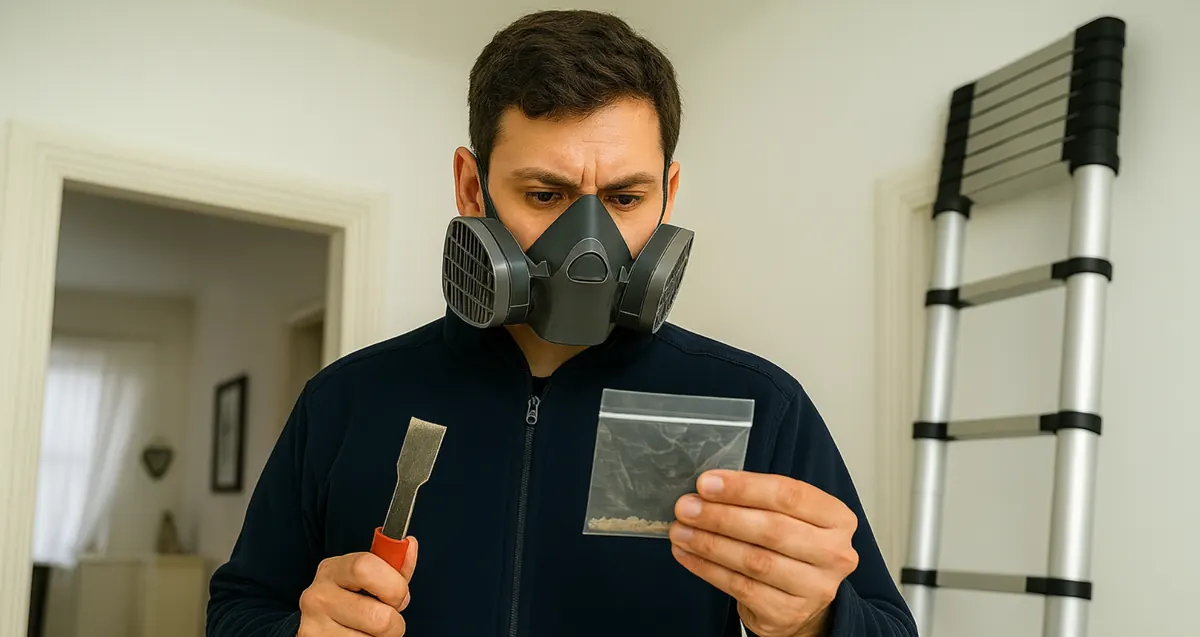
Buildings in St Johns built or refurbished before 2000 can contain asbestos. Our asbestos testing service covers sampling and lab analysis of suspect materials.
- Results builders ask for before work
- Artex ceilings before plastering, sanding or drilling
- Garage roofs before replacement
Asbestos testing in St Johns
Should you do it yourself?
Power tools, sanding and jet-washing release the most fibres.
Asbestos waste can’t go in household bins, recycling or skips. It has to go to a site that accepts it, and some councils accept small amounts from residents by arrangement.
Asbestos testing near St Johns
A test is a simple, definite way to find out. You’ll learn whether it contains asbestos and what kind, and we’ll explain what that means for your plans in St Johns. Whether it’s boiler cupboard panels and garage roofs before replacement, we deal with soffit boards, garage roof sheets and panels behind heaters and more.
In flats and conversions around St Johns, testing is often about one ceiling, one floor or a boiler cupboard before a refit, where a test is all that is needed. Clear answers come first: what the material is, and what that means for your plans.
- Location
- St Johns (SE13, SE10, SE8)
- Area hub
- Greater London
- Service
- Samples analysed by an accredited lab
- Afterwards
- A written result for each sample
- Quotes
- Quoted individually, in writing
- Phone
- 07833 053 749
- Page updated
- 26 October 2026
Common reasons for tests in St Johns
Textured coatings, floor tiles, cement sheets and boards can all look the same with or without asbestos, so appearance and age aren’t enough.
These are the materials and situations that most often lead to tests:
- Artex ceilings before plastering, sanding or drilling
- Checks before maintenance in rented homes
- Lab results for contractors before they start
- Porch canopies
Schools such as Ashmead Primary School should have an asbestos management plan, and staff can ask to see how it works.
Before you book anyone
- Which areas are covered, and which are not
- Survey methods in line with HSG264
- That samples are analysed by an accredited laboratory
- Insurance appropriate to asbestos work
How it works
Samples are small, bagged, labelled and recorded, then go off to the lab. We begin by confirming exactly what we are doing, so there is no confusion.
- Tell us what the material is, where it is, and send a photo if you can
- We agree how many samples are needed and send a quote
- We take each sample with wetting and controls, and seal it
- The samples are analysed by an accredited laboratory
- You get the written result, and we explain what it means
Preparing for the visit
- Keep away from the material in the meantime
- Clear belongings, but leave the material alone
- Tell us about parking and access
Ask for a quote
Tell us about the material, its location and your plans. Call 07833 053 749 or use our quote form.
Helpful guides
Choosing the right option
Testing or a survey? Testing checks the materials you’re worried about; a survey checks the whole building or work area. Small jobs typically just need a test. What you pay depends on the job itself: the materials involved, how much there is, access and paperwork. We quote each job individually.
Why choose us
- Recommendations in plain English
- Work done to the regulations
- Samples analysed by an accredited laboratory
- Honest advice, even when the answer is to leave it
See how we price jobs or the cost guide.
Testing around St Johns
St Johns is about 4 miles south-east of London, in Greater London. St Johns is within our Greater London area, for tests of every size. St Johns is one of 764 towns and villages in Greater London where we work.
For rented homes around St Johns station, you can test a material while the property is empty. For older homes anywhere in St Johns, from near Church of St John outwards, test any suspect materials before renovation.
Here we cover the SE13, SE10 and SE8 postcode area, and your test can be anywhere in it. Streets in the area include Avon Road, Mill Lane and Clare Road, and asbestos testing is available on all of them. St Johns sits on or near the A2210 and A2211, so mention parking if the property is on one. Other places close to St Johns we cover include New Cross (1 mile west), Deptford (1 mile north), Lewisham (1 mile south-east), Telegraph Hill (1 mile west) and Ladywell (1 mile south). Further out, we also cover London (4 miles north-west), City of Westminster (6 miles north-west), Marylebone (6 miles north-west), Kensington (8 miles west), St Pancras (6 miles north-west) and Shoreditch (5 miles north-west).
St Johns is in London, inside the Ultra Low Emission Zone, where parking and loading can be restricted: let us know about parking and access when you get in touch.
Nearby you will also find Miller General Hospital (less than half a mile north) and Nunhead (1.4 miles west). The countryside around St Johns includes Brookmill Road Local Nature Reserve and Tower Hill.
- Local schools include Addey and Stanhope School (less than half a mile north-west) and Laban Centre (0.8 miles north)
- Places of worship nearby include St. Paul's (0.7 miles north)
- Pubs nearby include Wickham Arms (0.5 miles west)
FAQs for St Johns
Do you work in St Johns despite London parking restrictions?
Yes, we work across London. Tell us about parking, permits and access so we can plan; all of Greater London is inside the ULEZ.
Do you work near St Johns station?
Yes. St Johns station is close to the centre of St Johns, and we cover the whole area.
Can you help with a flat?
Yes. For shared areas, ask the managing agent about the asbestos register.
Is a home built after 2000 likely to contain asbestos?
Buildings from after 2000 shouldn’t, because of the 1999 ban, although older materials can sometimes be reused or left in extensions.
Can you test Artex in St Johns?
Yes. A small sample of the coating is taken and analysed. Older coatings can contain a small amount of asbestos.
Do I need to be at home?
Someone has to let us into all the areas in the job.
What happens if the test is positive?
Your options depend on what it is, its condition and what work you are planning: leaving it, covering it or removing it.
Do I get anything in writing afterwards?
Depending on the job, a report, results or a consignment note.
Materials, one by one
Floor tiles and adhesive
Tiles are often found under newer floors; test them before they come up.
Textured coatings
Textured ceilings and walls are among the most common things people ask us to test. Older coatings can contain a small amount of asbestos.
After the job
Some results mean the work is licensed, and we will explain what that involves.
Staying safe afterwards:
- Keep the results for future work or a sale
- Group several materials into one visit
- Tell us if there’s adhesive under tiles
- Clear access to the area
What to avoid
Leave the material alone until the result is back.
Don’t break off a piece to test yourself; tell us where it is and we’ll sample it safely.
For landlords, agents and businesses
For managing agents and freeholders in St Johns, the asbestos register for common parts should be kept up to date and shared with contractors, and condition checked regularly.
Community buildings count as non-domestic premises, so whoever runs them has a duty to manage asbestos.
What’s included, and what isn’t
Every job has limits; these are the usual ones:
- Identifying the material is the first step; removal is planned separately
- Clearance testing is a separate, independent job
- We can’t confirm asbestos from a photo; only a lab can
If you are unsure, describe the job and send photos, and we will advise before you book.
Common materials
- Bitumen adhesive
- Panels behind heaters
- Floor tiles
- Pipe lagging
- Garage roof sheets
- Water tanks
- Artex and textured ceilings
- Soffit boards
- Roof felt
- Flue pipes
What else we do in St Johns
- Nothing removed blind: unknown materials are tested first
- Done to the regulations: HSE guidance and CAR 2012
- Everything in writing: quotes, reports, results and waste notes
- Asbestos waste double-bagged or wrapped and taken to a permitted site